

Rubber Expansion Joints Manufacturer for Industrial Piping Systems
Industrial rubber expansion joints (flexible rubber connectors) are engineered flexible piping elements designed to absorb mechanical vibration, relieve thermal movement stress, offset axial and lateral pipe misalignments, and reduce fluid-borne noise in pressurized piping systems.
Available in nominal diameters from DN25 to DN3000 (1 inch to 120 inches), our rubber bellows handle operating pressures up to PN25 (362 PSI) and temperatures ranging from -30 deg C to +200 deg C depending on elastomer selection. All units are manufactured in accordance with ISO 9001 procedures and fully pressure-tested prior to shipment.

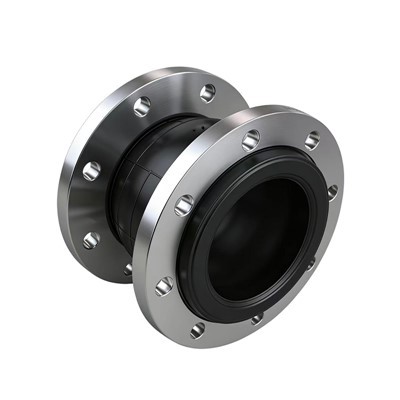


Single Arch / Sphere: Single-convolution body with floating metal flanges. Sizes: DN25 to DN3000 (1 inch to 120 inches). Primary function: Standard noise and vibration dampening at pump inlets and outlets.
Double Arch / Sphere: Twin-convolution elastomeric body. Sizes: DN40 to DN1000 (1.5 inches to 40 inches). Primary function: Extended axial, lateral, and angular movement capacities in compact spaces.
Threaded / Union Type: Threaded union ends (NPT / BSPT) with rubber body. Sizes: DN15 to DN80 (0.5 inches to 3 inches). Primary function: Small-bore HVAC lines, instrument piping, and booster pumps.
Wide Arch / Pipe Connector: Reinforced high-arch profile. Sizes: DN50 to DN2400 (2 inches to 96 inches). Primary function: Low stiffness requirement with higher non-directional movement.
Reducer Expansion Joint: Concentric or Eccentric rubber cone body. Sizes: DN50x40 to DN800x700. Primary function: Direct connection between unequal pipe sizes at pump nozzles.
Materials and Technical Specifications
Elastomer Selection Guide
EPDM: Working temperature -20 deg C to +120 deg C. Compatible media: Hot or cold water, steam under 120 deg C, weak acids, diluted alkaline solutions. Incompatible media: Mineral oils, petroleum derivatives, hydrocarbons.
NBR (Nitrile): Working temperature -15 deg C to +80 deg C. Compatible media: Crude oil, diesel, hydraulic oils, lubricants, compressed air with oil mist. Incompatible media: Strong acids, ozone, ketones, polar solvents.
Neoprene (CR): Working temperature -20 deg C to +90 deg C. Compatible media: Seawater, wastewater, mild chemicals, ozone, and weathering exposure. Incompatible media: Concentrated oxidizing acids, esters.
FKM (Viton): Working temperature -10 deg C to +200 deg C. Compatible media: Concentrated acids, solvents, high-temperature oils, aromatics. Incompatible media: Low-molecular-weight organic acids, ammonia.
Natural Rubber (NR): Working temperature -30 deg C to +70 deg C. Compatible media: Slurry, abrasive fluids, municipal raw water. Incompatible media: Ozone, oils, weathering exposure.
Physical Parameters and Tolerances
|
Parameter |
Specification |
|
Nominal Diameter |
DN25–DN3000 (1–120 in) |
|
Pressure Ratings |
PN10 (10 bar / 145 PSI), PN16 (16 bar / 232 PSI), PN25 (25 bar / 362 PSI), Class 150, Class 300 |
|
Vacuum Resistance |
Standard: -0.08 MPa; Vacuum Ring Reinforced: -0.1 MPa full vacuum |
|
Burst Pressure |
≥3 × working pressure rating |
|
Reinforcement Layer |
High-tenacity Polyester or Nylon Tire Cord Fabric, Multi-layer Matrix |
|
Flange Materials |
Carbon Steel (A105 / Q235B, Galvanized or Epoxy Coated); Stainless Steel (SS304, SS316, SS316L); Ductile Iron (QT450) |
|
Drilling Standards |
ANSI / ASME B16.5 Class 150/300; EN 1092-1 PN10/PN16/PN25; JIS 5K/10K/16K; BS 10 Table E |
Applications
HVAC and Building Services
Chilled water circuits, cooling towers, and circulation pump headers.
Municipal Water and Wastewater
Raw water intake, sludge lines, isolation valves, and desalination plants.
Power Generation and Heavy Industry
Condenser cooling lines, turbine exhausts, and flue gas scrubber systems.
Chemical and Petrochemical Processing
Process fluid transfer, slurry handling, and crude oil transport lines.
PTFE Liners: High-density PTFE or FEP internal liners cold-molded into the rubber carcass for zero-contamination chemical service and aggressive acid resistance.
Custom Control Rod Assemblies: Designed with elastomeric grommets for noise dampening or gusseted limit plates calculated for maximum thermal growth limits.
Offset and Custom Face-to-Face Lengths: Custom molding available for plant retrofit projects requiring exact replacement lengths without piping modifications.
Multi-Arch Configurations: Triple or quadruple arch designs for extreme settlement compensation in underground or marine piping.

Quality Control and Testing Standards
Every rubber expansion joint is manufactured under ISO 9001 quality management procedures and tested prior to dispatch.
Raw Elastomer Verification > Rheometer Vulcanization Test > Tire Cord Tension Test > Internal Curing Inspection > Hydrostatic and Leakage Test > Final Assembly Clearance
Hydrostatic Pressure Testing
100% shell test executed at 1.5 times design pressure for 15 minutes without pressure drop or structural deformation.
Elastomer Tensile and Elongation Test
Tensile strength equal to or greater than 15 MPa, elongation at break equal to or greater than 350% verified per batch using ASTM D412 standards.
Ozone and Aging Resistance
Accelerated thermal-aging tests (ASTM D573) ensuring long-term flexibility without surface crazing.
Manufacturing Standards Compliance
Designed in accordance with FSCA / EJMA guidelines and EN 14917 / HG/T 2289 standards.
Packaging and Delivery
Flange and Sealing Face Protection
Plastic end caps and wrapped corrosion-inhibitor film applied over elastomeric sealing beads and machined flange faces.
Plywood Case Packaging
Export-grade ISPM-15 compliant heat-treated wooden cases; large diameter units (greater than DN1200) fixed to custom heavy-duty steel skid frames.
Documentation Included
Manufacturer Test Certificate (EN 10204 3.1), Hydrostatic Pressure Test Report, Material Traceability Sheet, and Installation Guidelines.
Our Factory

FAQ
We're well-known as one of the most experienced rubber expansion joints suppliers in China. With abundant experience, we warmly welcome you to buy high quality rubber expansion joints in stock here and get quotation from our factory. For price consultation, contact us.
Double Sphere Flex Connector, Flanged Rubber Expansion Joint, rubber expansion joints